Nepal Safer Schools
Safer Schools, Resilient Communities
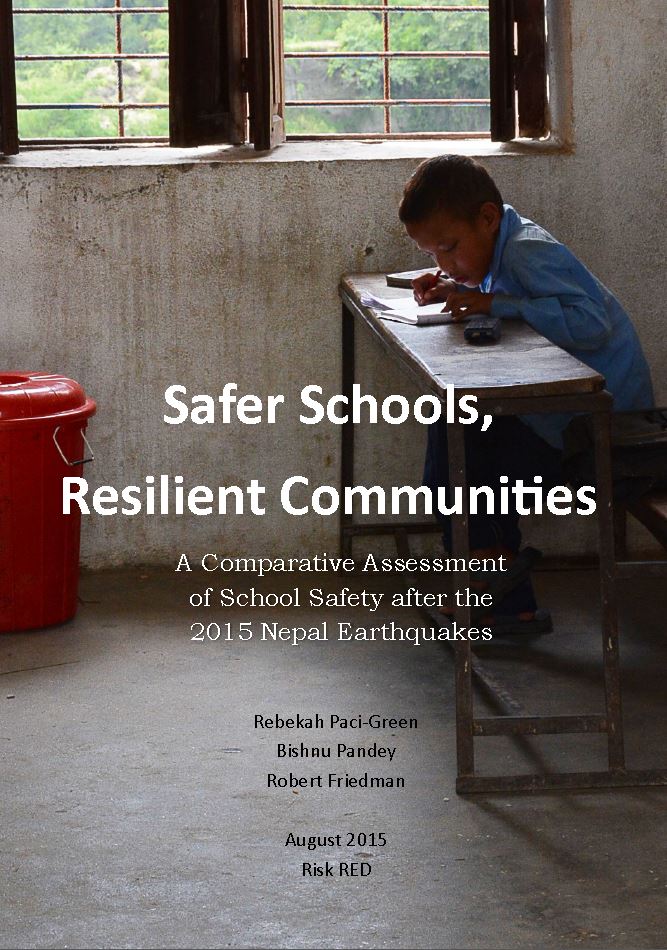
A Comparative Assessment of School Safety after the 2015 Nepal Earthquake — Download Report
We want to know exactly why schools collapsed, so it won't happen again.
Assessing the Damage
Need: On April 25, 2015, a massive M7.6 earthquake struck Western and Central Nepal, with an equally devastating aftershock of M6.8 striking Central Nepal on May 12, 2015, as measured by Nepal's National Seismic Centre. According to the Government of Nepal Ministry of Education, more than 27,000 classrooms were fully destroyed by these events, and more than 26,000 classrooms were partially destroyed.
The effects of the earthquake on Nepal's educational infrastructure offer a rare opportunity to study whether previous interventions to improve building practices, combined with community engagement, have resulted in safer schools and communities. We need to understand two basic questions:
- How did damage at purportedly disaster-resistant public school buildings, whether retrofitted or newly constructed, compare to damage of typical public school buildings?
- What effect, if any, did community engagement around safer schools have on risk awareness and community construction practices?
Partners: Risk RED's Dr. Rebekah Green & Dr. Bishnu Pandey were in Nepal for in-depth assessment of school safety during the summer of 2015. They were joined by Rob Friedman, former regional adviser to the Office of U.S. Foreign Disaster Assistance/USAID. They continue to work with governmental and non-governmental organisations to advocate for safer school reconstruction.
Approach: In Bhaktapur, Kathmandu, Rasuwa, and Sindupalchowk, we compared three, geographically proximal public schools:
- No intervention — typical construction
- Technical intervention only — disaster-resistant design or retrofit
- Technical and social intervention — disaster-resistant design or retrofit, combined with community engagement
At each site, we conducted interviews with school staff and management committees, parents, and lead masons involved in school construction. We also visually assessed school buildings and 15–20 nearby houses for damage.
What's Next: We are looking to extend this school safety assessment to analyze comprehensive post-disaster rapid damage assessment data and to develop a telephone survey, or a combination of purposive and random sampling of the remaining affected schools, in order to have a clearer picture of the extent of the problems and potential solutions identified in this study.